A lesson from Mars, modular robots, and the future of agentic AI
Here's a question that keeps us up at night at Salesteq: what if the most powerful AI systems aren't the ones we carefully design, but the ones we let loose?
Let us explain with a thought experiment.
The Problem with Sending a Perfect Rover to Mars
Right now, every Mars mission is an extraordinary act of engineering precision. Years of planning. Billions of dollars. One shot. We send a single, handcrafted machine, perfectly designed for conditions we predict based on incomplete information, and we hold our breath.
It works. Sometimes magnificently. But it's inherently fragile. One wrong terrain, one unexpected dust storm, one unanticipated mechanical failure, and the mission is over.
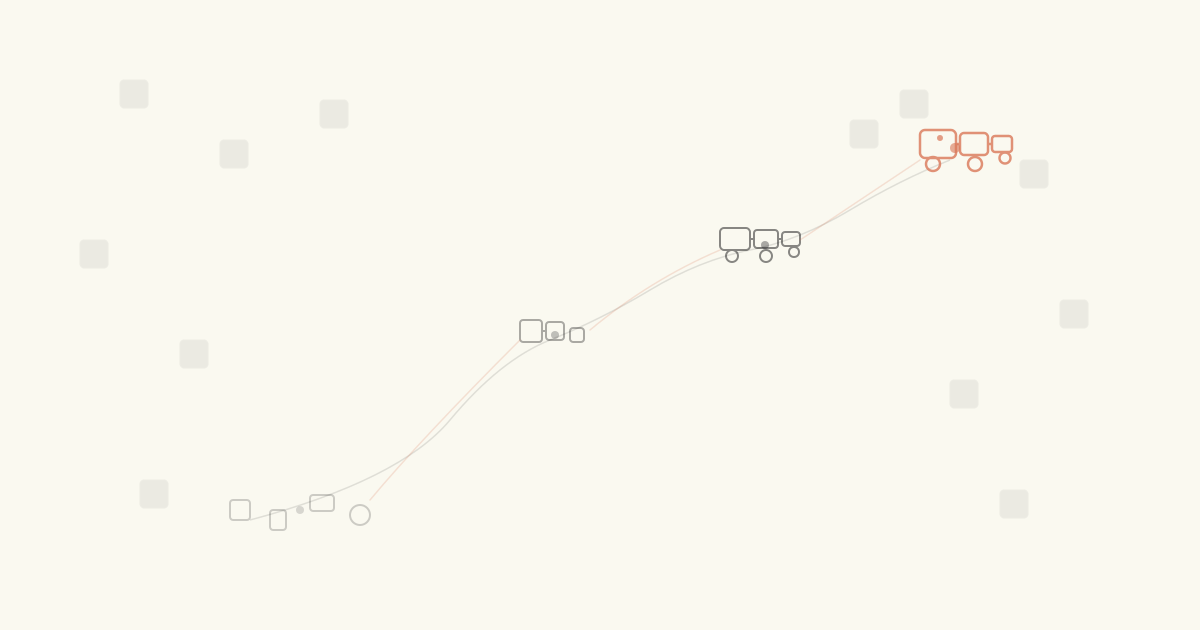
Now imagine a different approach. Instead of one perfect rover, we scatter thousands of cheap, simple, modular components across the Martian surface. No pre-assembled robot. No single point of failure. Just building blocks, hinges, frames, core units, tumbling out of a capsule and landing across kilometers of alien terrain.
And then they self-assemble. They adapt to whatever surface they land on. If one configuration doesn't work, the system evolves a better one. If components break, they get recycled into new forms. Engineers back on Earth didn't predict how it would turn out, and that's precisely the point. The system performs beyond what any engineer could anticipate, because it adapts to reality rather than to a model of reality.
This isn't science fiction. It's the core idea behind peer-reviewed research on modular evolutionary robotics, research that one of our founders contributed to, published in Frontiers in Robotics and AI.
The Science Behind the Analogy
The 2019 paper "Lamarckian Evolution of Simulated Modular Robots" explored a deceptively simple question: what if robots could not only evolve their bodies, but also teach their offspring what they had already learned?
In the research, modular robots were assembled from interchangeable components, fixed bricks, core units, active hinges, and set loose to evolve. Each generation developed new body shapes and movement patterns through mutation and recombination. But the key insight was what researchers called Lamarckian inheritance. When a parent robot learned an efficient gait through experience, it could pass that learned knowledge directly to its children. The offspring didn't start from scratch. They inherited their parent's hard-won wisdom and then built on it.
The results were striking. Robots under Lamarckian evolution converged on high performance far faster than those that had to relearn everything from zero each generation. More surprisingly, the shapes the robots evolved were different too. The knowledge transfer didn't just make robots smarter, it changed what forms were worth becoming.
The authors framed this within what they called the Triangle of Life: a robot is born, goes through an infancy learning phase, reaches maturity, reproduces, and the cycle begins again, each iteration smarter, better adapted, and more capable than the last.
The long-term goal, as the researchers put it, was a technology to produce highly adapted robots for many possible environments and tasks, not by designing perfect machines in advance, but by letting evolution and learning do the heavy lifting.
This Is Exactly What We're Building at Salesteq
We read that vision and saw something immediately familiar, because it's the same philosophy we're applying to agentic AI systems for business.
The way most companies approach AI automation today looks a lot like the traditional Mars rover model. Expensive. Carefully engineered. One workflow at a time. Months of configuration for each specific use case. Brittle when reality doesn't match the blueprint.
At Salesteq, we're taking the modular, evolutionary approach instead.
We're building an agentic system composed of specialized, interchangeable AI modules, each one a competent agent in its own right, handling research, outreach, qualification, follow-up, data enrichment, objection handling, and more. Like those robot components scattered on Mars, each module is cheap, replaceable, and designed to connect with others.
But here's where it gets interesting. Our agents learn from every interaction. What works in one context gets carried forward. Successful patterns propagate. Failed approaches get discarded. The system running your sales process in six months will be fundamentally more capable than the one you deploy today, not because we re-engineered it, but because it evolved.
And crucially, like the Lamarckian robots in that paper, knowledge doesn't die with each cycle. When an agent learns the right cadence for a particular customer segment or discovers that a specific opener converts better in a certain vertical, that learning is inherited by the next iteration. Nothing is unlearned. Everything compounds.
Why Modularity Is the Key
The Mars analogy reveals something important about why modular systems outperform monolithic ones in unpredictable environments, and enterprise sales is nothing if not unpredictable.
A monolithic system, however sophisticated, is only as good as the assumptions baked into its design. When the market shifts, when a new competitor emerges, when a customer segment behaves unexpectedly, a monolithic system struggles to adapt without a full rebuild.
A modular system adapts at the component level. Individual agents update, improve, or get replaced without disrupting the whole. New capabilities plug in without re-architecting the pipeline. The system doesn't just survive change, it feeds on it.
In the robotics research, robots with more modular, adaptable morphologies evolved more stable and higher-performing body plans over time. The same principle applies here: the more modularly our agentic systems are composed, the more surface area they have for improvement.
Beyond What Engineers Could Predict
The most exciting part of that research wasn't that the robots eventually performed well. It was that they performed in ways the researchers didn't design. The evolutionary process discovered body shapes and movement strategies that no engineer had specified, solutions that emerged from the interaction between the modules, the learning process, and the environment.
That's the promise we're chasing at Salesteq. Not an AI sales system that does exactly what we programmed, but one that discovers workflows, cadences, and approaches we didn't predict, because it's been exposed to your actual customers, your actual market, your actual reality.
We're not sending one perfect rover. We're sending thousands of components, letting them self-assemble around your pipeline, and watching what they become.
The results will surprise you. That's the whole point.
Want to see how modular agentic AI could evolve inside your sales process? Talk to us at Salesteq.